

How to Pass the NCLEX
If you're frustrated by not passing the NCLEX after multiple attempts, I've mapped out a simple easy-to-follow guide just for you.
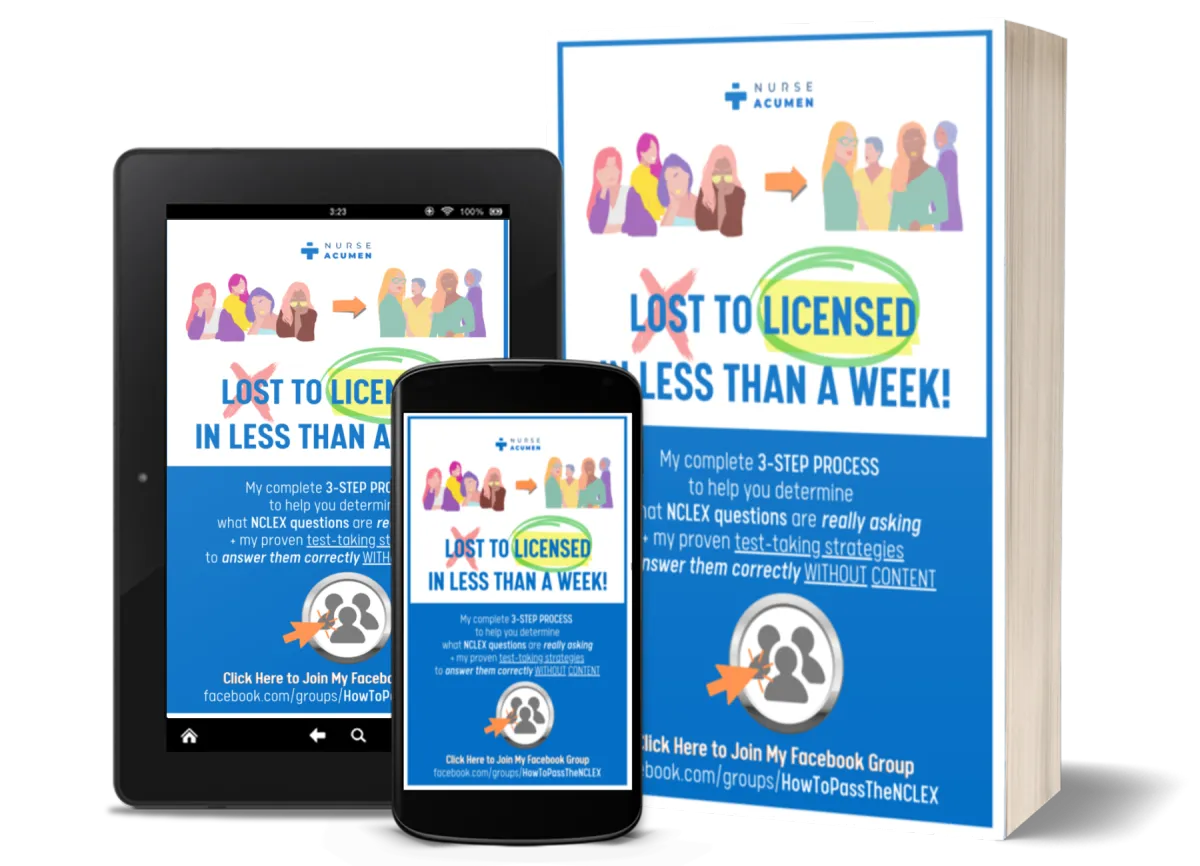
Learn the 3 steps to understanding what NCLEX-style questions are really asking, and the specific test-taking strategies to correctly answer them WITHOUT CONTENT!

Understanding the Next Generation NCLEX
“Life is like riding a bicycle. To keep your balance, you must keep moving.” - Albert Einstein
What's the biggest difference?
Aspiring nurses preparing to take the National Council Licensure Examination (NCLEX) to obtain their nursing license should be aware of the changes in the upcoming Next Generation NCLEX. While the traditional NCLEX measures a candidate's ability to provide safe and effective nursing care, the Next Generation NCLEX aims to assess candidate's critical thinking, clinical reasoning, and problem-solving abilities.
With that said, let's get into fully understanding the Next Generation NCLEX! 👊
Overview of Changes in the NCLEX
The Next Generation NCLEX is an updated version of the NCLEX exams that nursing candidates have been taking for many years. This new test format will assess learners’ competence in clinical judgement, a crucial skill for practicing nurses, which will prepare them to take on complex patient care situations.
One of the critical differences between the Next Generation NCLEX and previous versions is its emphasis on adaptive testing, which increases the test's accuracy and eliminates the need for test-takers to answer questions on subjects outside their proficiency level. Besides, the exam incorporates new item types, such as audio, video, and graphic selections, that reflect real-life nursing situations.
The Next Generation NCLEX reflects the dynamic nature of the medical field and the changing skillsets required for nursing professionals. For example, instead of multiple-choice questions or selecting answers from a drop-down menu, test-takers are presented with scenarios that require them to evaluate different pieces of information and prioritize care interventions.
Furthermore, students will have to answer questions while navigating electronic medical records or interacting with patients through a Telehealth platform. Such changes aim to improve the test's overall reliability and validity by gauging the mastery and readiness of nursing learners, who will ultimately serve the public as competent and skilled professionals.
In conclusion, the Next Generation NCLEX test is a positive development that facilitates a relevant and fair measure of nursing students' readiness for professional practice. The updated exam incorporates more complex scenarios that reflect real-world nursing situations and incorporate new item types such as audio, video, and graphic selections.
Additionally, the Next Generation NCLEX implements an adaptive testing model that personalizes the exam for each candidate and aims to address the test's accuracy issues. Therefore, nursing educators should prepare learners to take the Next Generation NCLEX with updated curricula that incorporate critical thinking, clinical judgment, and technological skills that will be essential for future nursing professionals.
The New NGN Format and Types of Questions
The Next Generation NCLEX (NGN) is a new version of the NCLEX exam that is being developed to test the competency of future nurses in taking care of patients based on the latest trends in nursing education and practice.
One of the major changes in the NGN is the new format and types of questions that will be included in the exam. These changes were made to better assess the ability of nurses to make informed clinical judgments and decisions, which are critical to providing safe and effective patient care.
The new format of the NGN will be computer-adaptive, which means that the difficulty level of the questions will be adjusted based on the previous answers of the test taker. This will help identify the level of the nurse's competency and provide a more accurate assessment of their knowledge and skills. The NGN will also include case-based scenario questions that will present real-life patient situations and ask the test taker to make decisions based on their assessment and analysis of the situation.
In addition, the NGN will also include various types of questions that require different levels of cognitive processing. For example, the exam will include multiple-choice questions, but also questions that ask the test taker to fill in the blank or select multiple answers.
The NGN will also include questions where the nurse will be required to demonstrate their decision-making skills by matching and ordering answers. By including a variety of question types, the NGN will provide a more comprehensive assessment of a nurse's competency in different areas.
Overall, the new format and types of questions in the NGN reflect the latest trends in nursing education and clinical practice. By adapting to these changes, future nurses will be better prepared to provide safe and effective patient care in a rapidly changing healthcare environment. It is important for nursing students and professionals to be aware of these changes and to prepare themselves accordingly for the NGN exam.
Expectations for Test Takers
The Next Generation NCLEX is a new adapted version of the National Council Licensure Examination (NCLEX) for aspiring nurses. While the traditional NCLEX assesses nursing students' knowledge and comprehension abilities, the Next Generation NCLEX evaluates their critical thinking, decision-making, and clinical judgment skills.
This test is designed to mimic real-life nursing scenarios, where students have to analyze a given situation and make an appropriate decision based on their knowledge, skills, and experience. Thus, test-takers should understand the expectations of the Next Generation NCLEX to perform well in the exam.
First and foremost, test-takers need to have a strong foundation in nursing concepts and procedures to answer the Next Generation NCLEX questions. Since the test emphasizes evaluating clinical judgment, decision-making, and prioritization skills, students should have a thorough understanding of the nursing process, patient assessment, care planning, and intervention strategies.
Furthermore, nurse educators recommend students to develop effective critical thinking and problem-solving skills to succeed in the exam. These skills enable nurses to analyze the data, assess the patient's needs, and make smart choices based on evidence-based practice guidelines.
Secondly, test-takers should be prepared to face multiple-choice and alternate format questions in the Next Generation NCLEX. The test may include scenario-based questions, where students have to read a situation and choose the best answer from a given list.
Additionally, students may face questions that require them to arrange the list items in the correct order, select all the correct options from a list, or highlight the text to answer the question. Thus, students need to practice these alternate format question types to get comfortable with them and understand how to approach each type.
Lastly, the Next Generation NCLEX expects students to have excellent time-management and priority-setting skills. Since the test has scenario-based questions that emulate real-life nursing situations, students may face situations where they have to decide whether or not to stop answering the current question to attend to a critical patient issue.
Therefore, test-takers must stay focused, manage their time well, and prioritize tasks effectively to succeed in the exam. In conclusion, understanding and meeting these expectations can help test-takers approach the Next Generation NCLEX with confidence and perform well in the test, eventually becoming competent and skilled nurses.
Preparing for the Next Generation NCLEX
As the nursing profession continues to evolve, so does the licensing exam that helps new nurses earn their credentials. The Next Generation NCLEX, or NGN, is the latest iteration of the NCLEX exam that aspiring Registered Nurses and Licensed Practical Nurses must pass before beginning their professional careers. The NGN is designed to assess nursing competency in a more current and comprehensive way, using a range of new strategies, including new question types and assessment methods.
Preparing for the Next Generation NCLEX is critical to success in your nursing career. The NGN has been in development for several years, and there are many resources available to help nursing students and recent graduates prepare for this challenging exam.
Some important steps to take to prepare for the NGN include researching test-taking strategies, reviewing nursing textbooks and study guides, and taking practice exams to familiarize yourself with the new question types and assessment methods. It's also important to stay up-to-date on changes to the NGN and keep abreast of any new developments in nursing education.
Taking the Next Generation NCLEX can be a daunting task, but with the right preparation, you can approach the exam with confidence and succeed in your nursing career. Preparing for this new exam may require extra time and effort, but it's essential to ensure that you possess the skills and knowledge required to be a successful and effective nurse.
The NGN is designed to test nursing competency in a more comprehensive and current way, so staying up-to-date on current clinical practices and nursing education will be fundamental for a successful career in the profession.
Final Thoughts
In conclusion, understanding the Next Generation NCLEX is crucial for aspiring nurses as it significantly differs from the previous NCLEX format. Due to the new testing format, candidates need to develop their problem-solving abilities and nursing skills to provide safe patient care.
As nurses are responsible for patients' safety, the NCLEX exam's focus on critical-thinking skills and clinical reasoning offers a comprehensive evaluation of nursing candidates' competencies. Thus, preparing adequately for the exam is essential to becoming a competent, knowledgeable, and efficient registered nurse.

NEXT GENERATION NCLEX "CLEAR PASS" CHECKLIST:
Here's a quick checklist to help you prepare to pass the Next Generation NCLEX. Remember imperfect action beats inaction, so get started and let's get licensed!
Understand the test format
Know the test content
Get help if needed. If you are stuck, you can get help here
Create a study plan
Use study materials
Take practice tests
Focus on your weak areas
Stay organized
Take care of yourself
© 2023 Nurse Acumen Coaching LLC. All rights reserved.